Who can change a listening Leviathan?
AI agents could make government easier to talk to. The political possibilities depend on how citizens can turn that conversation into changes to the rules, including the rules for making decisions.
Imagine telling a government agent that you have had a child. With your permission, it updates the relevant records and helps you apply for support. You no longer have to understand the administrative structure before receiving help.
Then one application is rejected. The agent explains the eligibility rule. It has applied that rule correctly, but you believe the rule is unjust. Other families in similar circumstances face the same exclusion. What can you do together to change it?
That is the question I keep returning to when I think about a state we can talk to. An administration could become extraordinarily good at explaining its decisions while leaving citizens with little influence over how those decisions are made.
The 2025 vision paper published by AgenticState.org proposes a transformation of public administration through AI agents that coordinate work and act within defined boundaries. Human officials retain responsibility for political direction and judgment. I am interested in what this framework leaves politically open: who controls these systems, who can challenge them, and who can change how they work.
I can imagine several agentic states. One might preserve parliamentary government while changing how its administration works. Another might give citizens’ assemblies authority over certain decisions. A third might concentrate control in a small executive group, whose agents collect information and carry out instructions across public institutions. Some could share technical components while distributing political power very differently.
A more technically advanced state would not necessarily be a more democratic one. The same capabilities could operate under very different political arrangements. What matters is who sets their objectives, whose objections count and who can authorize a change.
Take the disputed benefit. A minister might decide whether to reconsider its eligibility criteria. A parliamentary committee might investigate. A citizens’ assembly might examine alternatives under a mandate agreed in advance. The same interface could receive the parent’s objection in each case. Behind it would be different routes into public decisions.
The difficult part is not only teaching the agent to understand the citizen. It is deciding how a political principle becomes a procedure that software can actually follow.
A tax rate is relatively easy to express as a number. A commitment to equal treatment leaves much more to decide. Which differences between households are relevant? What evidence should count? Who may challenge the categories? Political disagreement continues inside the definitions a system needs in order to act.
Even a principle as straightforward as the right to seek a review requires choices. Someone must decide who hears the request, whether the disputed action continues during the review, and what authority the reviewer has. Software can support those arrangements through permissions and records. If a developer fills in a missing requirement without public scrutiny, that technical choice can determine whether the right is usable.
Generative AI adds another place where interpretation occurs. In my interview with Simone Maria Parazzoli, a co-author of the vision paper, we discussed what happens when AI agents sit between legal language and execution, including how much ambiguity and nondeterminism governments can accept. An agent may interpret an ambiguous instruction, but its answer cannot settle what the instruction ought to mean. There must be a way to challenge both the action and the interpretation behind it.
Political language is unlikely simply to disappear into code. We may instead end up with political principles written for people and parts of their implementation written for machines. The important question is whether people can see the connection between the two, especially when the software behaves in ways that conflict with the principle it is supposed to implement.
While developing Democracy Routes, I approached a smaller version of this problem through Workflow Democracy. I proposed a visual editor in which people could connect discussions, participant selection and decisions into governance processes. The original proposal includes concept drawings and a front-end prototype. Its purpose was to let people with political experience contribute to the design without first becoming software specialists.
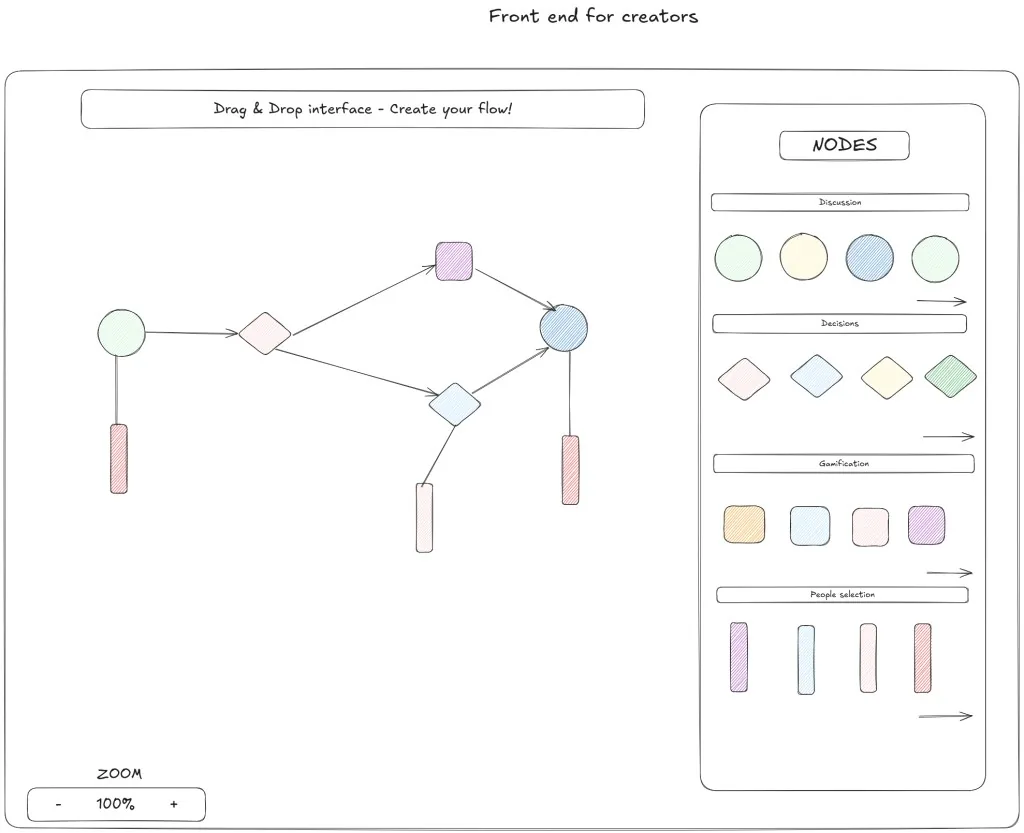
A group could compare two versions of a process. In one, participants submit proposals and a committee chooses which reach a vote. In another, participants can require a vote once a proposal meets an agreed threshold. Drawing those paths would make the committee’s power easier to identify and debate. Political philosophers could contribute alongside organizers and people whose experience is of being excluded by a procedure.
Moving such an approach into government would require much more than connecting boxes. A state exercises authority over people who may never choose to use its platform. Public procedures have to accommodate rights and responsibilities beyond the preferences of those currently participating. A diagram could help people examine these obligations, but adopting it would require a legitimate decision about who may exercise which powers.
Now return to the families excluded from the benefit. A government agent might detect similar complaints and report a pattern to officials. The affected people could still remain isolated from one another. A useful system would let them choose to contribute to a collective review without making their individual case files public. They would also need ways to organize independently of the government’s interface.
In my conversation with Tiago Peixoto, another co-author of the Agentic State vision paper, he emphasized the relationship between participation and collective action. People can make arguments through an official process, while organizing outside it creates pressure that makes those arguments harder to ignore. A state that receives everyone’s feedback can still decide to disregard it.
Suppose 70 percent of the people affected object to the benefit rule. What should happen then? Should that trigger a parliamentary review, a citizens’ assembly, a referendum, or simply require the administration to respond? The number itself cannot answer those questions. Someone still has to decide what procedure follows from public disagreement and who has the authority to make the final decision.
Citizens should also be able to question that procedure. A threshold may exclude smaller groups, or officials may repeatedly delay a response. If people can challenge the benefit rule but cannot challenge the rules for changing that rule, their influence remains limited.
My interview with Massimo Bugani about the Rousseau platform offers a useful example from digital politics. Bugani, who was involved in Rousseau from its early development, described a platform through which members of the Five Star Movement could take part directly in political decisions. Looking back on that experience, however, he also argued that parties, associations, unions and other forms of political intermediation still have a role. Political questions are complex, and direct participation does not remove the need for people and organizations that spend time working on them.
That experience makes the choice less simple than direct participation versus political representation. In my interview with Hélène Landemore, she made a different argument about representation. Not everybody can participate in politics all the time. Her model remains representative, but representatives can be selected by lot rather than through elections: temporary groups of ordinary citizens can do political work with the consent of the larger population, and she would not institutionalize such a system without a moment of constitutional approval by everyone.
Terry Bouricius pushes sortition further. His proposal does not replace an elected chamber with one randomly selected chamber that does the same job; he considers a single chamber a bad design whether its members are elected or drawn by lot. Instead, different bodies perform different functions: a randomly selected body sets the agenda, drafting is open to anyone who wants to take part, a randomly selected panel works the drafts into a final bill, and a separate jury hears the arguments and votes to adopt or reject it. In his account, the executive should primarily administer decisions rather than generate policy itself. His design also includes a randomly selected rules committee whose only job is to watch how the other bodies perform and change the rules they run on.
Neither Landemore nor Bouricius was talking about the Agentic State. The connection is mine. Their work suggests another way of thinking about who might control a state that becomes easier to configure. Direct access to government does not mean that every citizen has to decide every question. Authority could be distributed among the wider public, elected institutions and temporary groups of citizens selected for particular tasks.
A citizens’ assembly, for example, could remain advisory. But it could also be given authority over a defined part of an agentic system: reviewing a rule, approving a change to a procedure, or deciding whether an agent should be allowed to perform a particular function. The technical system cannot tell us whether that arrangement is democratic. That depends on who has authority, how they receive it and how it can be challenged.
Governments could also reuse procedures developed elsewhere. Italy might adapt a citizens’ assembly process first tested in France, for example. But copying the workflow would not be enough. We would also need to know what authority the participants actually had, what resources supported the process and who was allowed to change it.
Even a legitimately approved change is useless if the institution lacks the technical capacity to implement it, or depends on a supplier that will not. Technical control also has to follow political authority. Citizens should be able to see who authorized an important change and what it affects. The ability to update or suspend an agent should follow an accountable mandate. Possessing the administrator’s password cannot be the basis for deciding how the state works.
Hobbes’s Leviathan gives me an image for this encounter with sovereign power. I would welcome a state that is easier to speak to and more capable of acting on people’s needs. I also want room for people to change what it understands its responsibilities to be.
The parent who questions a benefit rule should be able to pursue a correction, join others in seeking a different rule, and challenge the procedure through which that change is considered. A listening Leviathan could help make those paths accessible. Whether citizens have the authority to use them is a political choice we still have to make.
Disclosure: I host Democracy Innovators and conducted the interviews discussed here. I develop Democracy Routes and Agentic Party, and proposed Workflow Democracy. The illustration comes from my original Workflow Democracy proposal.
AI disclosure: I used generative AI for editing, language support, and source checking. The research questions, arguments, interviews, and examples are my own.